7 Best String Trimmer and Blower Combos (October 2026)
The best string trimmer and blower combos include the Greenworks 40V Trimmer and 390 CFM Blower Combo for everyday yard cleanup, the WORX WG928 Trimmer and 360 CFM Blower Kit for sidewalk edging, and the Greenworks 60V Trimmer and 540 CFM Blower Combo for larger cleanup jobs.
On this page (7 sections)
- Which string trimmer and blower combo fits your yard?
- How do you choose the right trimmer for your borders?
- Which blower features matter for your cleanup?
- How many batteries does a combo need?
- How should you set up and use a new combo?
- Which mistakes shorten a combo's useful working time?
- Which string trimmer and blower combo should you choose?
The Greenworks 40V Trimmer and 390 CFM Blower Combo is the best string trimmer and blower combo for routine lawn edges and clearing clippings from hard surfaces. Choose WORX WG928 for frequent edging, or Greenworks 60V when leaf cleanup is a larger part of the job.
Buy around the work you do after mowing: trimming grass the mower missed, maintaining borders and clearing paths. A useful combo handles all three without making you buy into a battery system that doesn't suit your yard.
If you need only a trimmer, compare our best battery string trimmers. For a closer look at border maintenance, see string trimmer and edger combos.
Our picks at a glance
-
1
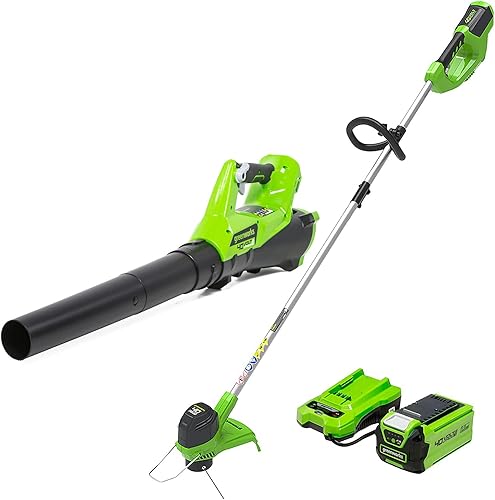 Best for everyday yard cleanup
Greenworks 40V Trimmer and 390 CFM Blower Combo
8.4/10 our score
See it on Amazon -
2
 Best for sidewalk edging
WORX WG928 Trimmer and 360 CFM Blower Kit
8.2/10 our score
See it on Amazon -
3
 Best for larger cleanup jobs
Greenworks 60V Trimmer and 540 CFM Blower Combo
7.9/10 our score
See it on Amazon
- 4
 Check it
WORX WG930.2 3-in-1 Trimmer and Blower Kit
Best for mixed lawn borders - 5
 Check it
CRAFTSMAN V20 Trimmer and Blower Combo
Best for existing V20 users - 6
 Check it
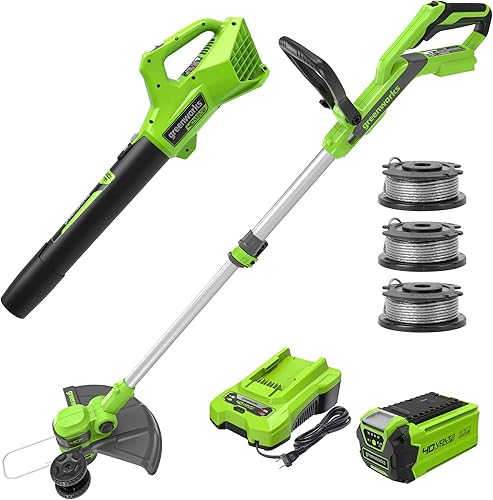
Greenworks 40V Trimmer and 350 CFM Blower Combo
Best for grass-first maintenance - 7
 Check it
Greenworks 24V Trimmer and 515 CFM Blower Combo
Best for shared household use
Which string trimmer and blower combo fits your yard?
Choose the Greenworks 40V 390 CFM kit for regular trimming followed by a short cleanup. Move to an edging-focused WORX kit for sidewalk borders, or the Greenworks 60V pair for a bigger blowing workload.
SundaySmarts compared line-feed systems, edging features, blower controls and included battery supplies. The order favors a useful routine-yard pair over choosing the largest blower alone.
| Product | Best for | Cutting width | Blower airflow | Battery | Our score |
|---|---|---|---|---|---|
| Greenworks 40V Trimmer and 390 CFM Blower Combo | everyday yard cleanup | 12 in | 390 CFM | 40V, 2.0 Ah included | 8.4 |
| WORX WG928 Trimmer and 360 CFM Blower Kit | sidewalk edging | 12 in | 360 CFM | 20V PowerShare, two batteries included | 8.2 |
| Greenworks 60V Trimmer and 540 CFM Blower Combo | larger cleanup jobs | 13 in | 540 CFM | 60V, 4.0 Ah included | 7.9 |
| WORX WG930.2 3-in-1 Trimmer and Blower Kit | mixed lawn borders | 12 in | 360 CFM | 20V PowerShare, two batteries included | 7.7 |
| CRAFTSMAN V20 Trimmer and Blower Combo | existing V20 users | 13 in | 340 CFM | V20, 4.0 Ah included | 7.4 |
| Greenworks 40V Trimmer and 350 CFM Blower Combo | grass-first maintenance | 13 in | 350 CFM | 40V, 2.0 Ah included | 7.3 |
| Greenworks 24V Trimmer and 515 CFM Blower Combo | shared household use | 12 in | 515 CFM | 24V, 3.0 Ah included | 6.9 |
Match the string trimmer and blower combo to both chores
Start with whichever chore takes longer. A long fence line makes trimmer comfort and line handling important, while a broad driveway under trees puts more weight on the blower and spare battery supply.
A combo is less useful if one tool doesn't fit. If your existing blower already handles cleanup, buying a better standalone trimmer may make more sense than replacing both.
Greenworks 40V Trimmer and 390 CFM Blower Combo: Best for everyday yard cleanup
- 12 in cutting width
- 390 CFM blower
- Auto-feed trimmer line
- Blower cruise control
A practical pair for regular lawn edges and clearing clippings from walks. Automatic line feed and blower cruise control keep the controls simple.
Pros
- Automatic line feed
- Blower cruise control
- Included battery fits compatible Greenworks 40V tools
Cons
- One included battery shared between tools
- Narrower cutting path than the 13 in picks
This Greenworks pair suits a yard that gets regular attention rather than an occasional major clear-out. Its 12 in cutting path and .065 in auto-feed line fit grass around beds, fence posts and places a mower cannot reach.
The blower supplies 390 CFM and 110 MPH, with cruise control to hold your chosen setting. That control is useful on a long walkway where you want steady airflow without holding the trigger at one position.
The included 40V 2.0 Ah battery serves both tools, so plan to trim first and blow afterward. If two people usually split those chores, you'll need another compatible battery to use both tools at once.
Buy this kit for a straightforward weekly routine and a place in the Greenworks 40V platform. Skip it if wheeled edging is your main requirement, or if large leaf piles regularly take longer than trimming the whole yard.
WORX WG928 Trimmer and 360 CFM Blower Kit: Best for sidewalk edging
- 12 in cutting width
- 360 CFM blower
- Pivoting trimmer head
- Two batteries and charger included
Choose this kit for grass borders that need regular edging followed by a quick sweep of clippings. Push-button line feed puts line advance under your control.
Pros
- Pivoting head for edging
- On-demand line feed
- Two batteries and charger included
Cons
- Less blower airflow than the larger Greenworks options
- No wheeled edging configuration described for this kit
The WG928 is a better match for frequent sidewalk and driveway edging than for a yard dominated by leaf removal. Its head pivots into an edging position, so you can switch from cutting horizontal grass to maintaining a vertical border.
Command Feed advances line when you press a button. That suits someone who wants to choose when to release fresh line rather than use automatic feed or bump the head.
The blower delivers up to 360 CFM and 75 MPH for clippings, dry leaves and loose debris. Two batteries and a charger are included, giving you a battery for each tool or a spare to rotate through the job.
Choose it for a lawn with several paved borders and routine cleanup afterward. Skip it if you specifically want a wheeled edging setup, and don't choose it primarily for clearing broad areas of wet, packed leaves.
Greenworks 60V Trimmer and 540 CFM Blower Combo: Best for larger cleanup jobs
- 13 in cutting width
- 540 CFM blower
- Dual-line bump feed
- 4-year limited tool and battery warranty
The strongest blower airflow in this group makes this the first option to consider for larger leaf-clearing areas. Its dual-line trimmer suits thicker grass and weeds.
Pros
- Highest airflow in this roundup
- Turbo blower mode
- Greenworks 4-year limited tool and battery warranty
Cons
- One battery shared between tools
- Bump feed requires manual line advance
The Greenworks 60V kit is the first pick to consider when blowing takes as much effort as trimming. Its blower has the highest airflow here at 540 CFM, reaches up to 140 MPH and includes turbo mode.
The trimmer uses a 13 in cutting path with .080 in dual-line bump feed. It suits thicker grass and weeds better as a buying priority than a kit chosen mainly for edging conversions.
A 4.0 Ah battery and charger are included, and Greenworks backs both tools and the battery with a 4-year limited warranty. One pack serves the pair, so a longer trimming session can leave less charge for blowing.
Choose this kit for more demanding grass maintenance and larger cleanup areas. Skip it if your work is mostly a few short borders and a patio, or if you prefer automatic line advance over operating a bump-feed head.
WORX WG930.2 3-in-1 Trimmer and Blower Kit: Best for mixed lawn borders
- 12 in cutting width
- 360 CFM blower
- Converts to wheeled edger and mini-mower
- Two batteries and dual charger included
A wheeled edger and mini-mower mode suit yards with several kinds of small grass areas. The dual charger supports a two-battery routine.
Pros
- Trimmer, wheeled edger and mini-mower modes
- Telescoping shaft
- Two batteries and dual charger included
Cons
- Mode changes add setup steps
- Mini-mower mode does not replace a full-size mower
The WG930.2 suits a yard with paved edges, narrow grass strips and small awkward patches. Its trimmer converts without tools into an in-line wheeled edger or mini-mower, giving each of those areas a different working setup.
The wheels provide a reference along a hard border, while the mini-mower mode gives you another way to approach a small patch. That mode is for limited areas, so keep a full-size mower for the main lawn.
The kit includes two 20V 2.0 Ah batteries, a dual charger and three 10 ft spools. Its telescoping shaft helps adjust reach, and the blower offers two speeds with up to 360 CFM.
Choose this pair if you'll use the extra configurations regularly. Skip it if you only trim around a fence and blow the walk, because the simpler WG928 already covers trimming, pivot-head edging and cleanup.
CRAFTSMAN V20 Trimmer and Blower Combo: Best for existing V20 users
- 13 in cutting width
- 340 CFM blower
- Automatic line advance
- 4.0 Ah battery included
A useful addition to a compatible CRAFTSMAN V20 collection when trimming matters more than heavy leaf cleanup. The telescoping pole helps you set a comfortable working position.
Pros
- Automatic line advance
- Telescoping pole
- Dual-speed blower
Cons
- Lowest blower airflow in this group
- One included battery shared between tools
The CRAFTSMAN combo makes the most sense for homeowners already using compatible V20 tools. Adding another tool pair and a 4.0 Ah battery can be more useful than starting a separate charging setup.
Its trimmer has a 13 in cutting swath, automatic .065 in line advance and a telescoping pole. Adjust the pole before starting so you can keep the head near the grass without bending forward throughout the job.
The blower supplies up to 340 CFM and 90 MPH, with two speeds. Use the lower setting for light cleanup and reserve the higher setting for debris that needs more force.
Choose this kit when grass trimming leads the workload and blowing is a final pass over paths. Skip it if leaf clearing drives the purchase, since this is the lowest-airflow blower in the group and the higher-airflow options deserve priority.
Greenworks 40V Trimmer and 350 CFM Blower Combo: Best for grass-first maintenance
- 13 in cutting width
- 350 CFM blower
- Auto-feed line
- Three bonus spools included
Choose this set when trimming grass is the main chore and blowing is a short final step. Three bonus spools put replacement line within reach.
Pros
- Three bonus spools
- Automatic line feed
- Greenworks 3-year limited tool and battery warranty
Cons
- Less airflow than the other Greenworks 40V pick
- One included battery shared between tools
This Greenworks 40V kit fits a grass-first maintenance routine with a short cleanup at the end. Its 13 in trimmer uses .065 in auto-feed line, while the 350 CFM blower handles dry leaves and light debris.
Three bonus spools come with the battery and charger. Those spares are useful if your trimming route includes a lot of posts and borders, where contact with hard surfaces can wear line quickly.
The included battery is a 2.0 Ah pack, and Greenworks backs the tools and battery with a 3-year limited warranty. Keep the shared battery supply in mind if your trimming route is long.
Choose this set if you value the wider trimming path and ready replacement spools within the 40V platform. Skip it if blowing is the bigger chore, because the other Greenworks 40V kit offers more airflow and blower cruise control.
Greenworks 24V Trimmer and 515 CFM Blower Combo: Best for shared household use
- 12 in cutting width
- 515 CFM blower
- Adjustable telescoping shaft
- 3.0 Ah battery and USB-C charger included
The adjustable shaft suits households where people of different heights share yard work. A variable speed trigger helps control debris around beds and patios.
Pros
- Adjustable shaft and edging conversion
- Brushless motors in both tools
- Blower variable speed and cruise control
Cons
- Separate platform from Greenworks 40V and 60V
- One included battery shared between tools
The Greenworks 24V pair is worth considering when different household members share yard work. Greenworks describes the telescoping shaft as accommodating users from 4 ft 8 in to 6 ft 5 in tall, and the trimmer converts to an edger.
Both tools have brushless motors. The blower delivers 515 CFM and up to 130 MPH, with a variable speed trigger for changes in airflow and cruise control for a steady setting.
The kit includes a 3.0 Ah battery, a 65W USB-C charger and a 3 ft charging cable. The charger also works with compatible USB-C devices, which adds convenience if you already use that charging connection.
Choose it for adjustable fit and controlled blowing around mixed surfaces. Skip it if your goal is sharing batteries with Greenworks 40V or 60V tools, since this pair belongs to the separate 24V platform.
How do you choose the right trimmer for your borders?
Choose comfortable reach and the right cutting task before focusing on a small difference in cutting width. A wider swath covers more grass per pass, but it doesn't solve poor balance, an awkward shaft position or the wrong tool for woody growth.
Long fence runs need a steady working position. Beds with close planting need careful control, while long paved borders make a dedicated edging position or wheels more useful.
Match the feed system to your working style
Automatic feed suits someone who wants the tool to manage line advance. Push-button feed gives you direct control, while bump feed releases line through a deliberate action described in the tool's manual.
None of these systems removes the need to replace line. Learn the head's opening method before your first yard session, and keep the correct replacement spool or line nearby.
Don't fit thicker line to compensate for letting grass grow too long. Use approved line and take smaller passes through dense growth rather than forcing the head into it.
Separate grass trimming from brush clearing
String trimmers maintain grass and suitable weeds around obstacles. Woody stems, saplings and dense brush call for a tool designed for that work.
If clearing rough growth is your main task, read string trimmer vs brush cutter before choosing a combo. A useful blower won't make an unsuitable cutting tool a better match.
Our cordless string trimmer buying guide explains how cutting width, batteries and line systems fit together. For spool changes, follow how to load line in a string trimmer.
Which blower features matter for your cleanup?
Choose airflow for moving volume and speed control for placement. Clearing a broad patch of loose leaves is different from moving clippings beside mulch, where too much force can create another cleanup job.
CFM measures air volume, while MPH describes air speed. Consider both, but put the debris and surface first: dry leaves on pavement move more easily than damp leaves caught in grass.
Plan for wet leaves and planted areas
For wet leaves, loosen compact piles with a rake and move smaller amounts at a time. Even a higher-airflow handheld blower is easier to use when you avoid pushing a whole soaked pile in one pass.
Near flower beds, lower the airflow and aim across the hard surface rather than into the mulch. Start away from the bed and work toward your collection area.
Cruise control suits an open stretch where the same setting works for several passes. A variable trigger helps when the route shifts between open pavement, corners and planted areas.
Avoid choosing the largest airflow figure for a tiny enclosed patio. Control, handling and a short route to the collection point may matter more there than maximum output.
How many batteries does a combo need?
One battery works for sequential chores; two give you more flexibility. A single-pack kit can suit a short trim-then-blow routine, while a second compatible pack helps with longer routes or two people working together.
Don't assume the included battery will finish both tasks on every yard. Dense grass, longer line, sustained blower speed and the amount of debris all affect how quickly charge is used.
Compare capacity within the same platform
Amp-hour figures help compare battery capacity within a compatible system. They don't give a direct runtime comparison across different voltages, tools and workloads.
Higher voltage also doesn't establish battery compatibility. Match the exact platform, and remember that Greenworks 24V, 40V and 60V are separate systems.
If you already have suitable batteries, think about their condition and whether your charger can keep up. Owning a platform helps most when the available packs can support the work you actually do.
Our guide to whether 20V is enough for a string trimmer explains the voltage tradeoffs. You can also compare standalone choices in our best electric string trimmers guide.
How should you set up and use a new combo?
Assemble, adjust and inspect both tools before inserting a battery. Fit the guards and handles as directed, check that parts are secure and read the instructions for line feed, charging and edging conversion.
Walk the route first and remove wire, toys, stones and loose objects. Wear eye protection, sturdy shoes and long pants, and follow the manual's guidance on hearing protection and keeping others clear.
Set the trimmer for an upright stance
Adjust the shaft and handle, where available, so you can stand upright with both hands in a natural position. Keep the guard fitted and avoid reaching so far that you lose control of the head.
Trim with the line tips rather than pushing the whole head into grass. For tall growth, reduce it in stages instead of cutting at ground level in one heavy pass.
Stay clear of tree bark, fence wire and delicate stems. A spacer guard can help with positioning, but it doesn't make contact with plants harmless.
For paved borders, work slowly enough to keep the cut consistent. Our guide to how to edge with a string trimmer explains the technique and how to avoid digging a trench.
Finish with a planned blowing route
Mow and trim before the final blowing pass. Start at the far end of the area and move debris toward one collection point, using the wind when it helps.
Keep debris on your property and out of streets, drains and neighboring yards. Bag or compost suitable material rather than blowing the same pile from one corner to another.
Which mistakes shorten a combo's useful working time?
The main avoidable mistakes are running maximum blower output everywhere, forcing the trimmer and neglecting line length. Match power to the job and keep the cutting head clear so battery charge goes into useful work.
Short line reduces cutting reach and can tempt you to push harder. Excess line or an incorrect line size can overload the tool, so keep the guard's line-cutting parts in place and follow the manual.
Stop before clearing a jam
Release the trigger, remove the battery and wait for moving parts to stop before clearing wrapped grass or opening the head. Never reach into the blower intake or nozzle while its battery is installed.
If a tool stops repeatedly, check for a blockage, wrong line or excessive load before restarting. Let a hot battery cool according to its instructions rather than trying to continue through repeated shutdowns.
Clean and store the pair after use
With the battery removed, brush clippings from the trimmer guard and head, then clear the blower's external intake openings. Keep vents open and avoid directing water into motors or battery connections.
Store tools and batteries in a dry place within the temperature limits in their manuals. Follow the battery instructions for charging and long-term storage, and don't leave a pack in direct sun or a hot vehicle.
Keep replacement line dry and organized with the tool. Finding the correct spool before it runs out is easier than stopping halfway through a border to work out what fits.
Which string trimmer and blower combo should you choose?
Choose the Greenworks 40V 390 CFM combo if you want a regular trim-and-clean routine with simple controls. Choose WORX WG928 for frequent pivot-head edging, or WG930.2 when wheels and small-patch mowing will earn regular use.
Pick Greenworks 60V when leaf clearing is a substantial chore. The CRAFTSMAN suits existing V20 users, the Greenworks 40V 350 CFM kit favors grass maintenance, and the Greenworks 24V pair suits shared use where adjustable fit matters.
Before ordering a string trimmer and blower combo, count your available batteries and decide where the debris will go. If neither tool pair fits both jobs, compare our best string trimmers for home use and build around the chore that needs the better tool.
Our top 3 picks at a glance
-
1
Best for everyday yard cleanup
Greenworks 40V Trimmer and 390 CFM Blower Combo
8.4/10 our score
See it on Amazon -
2
Best for sidewalk edging
WORX WG928 Trimmer and 360 CFM Blower Kit
8.2/10 our score
See it on Amazon -
3
Best for larger cleanup jobs
Greenworks 60V Trimmer and 540 CFM Blower Combo
7.9/10 our score
See it on Amazon
Frequently asked questions
What should I compare in a string trimmer and blower combo?
Compare your trimming workload, blower controls, edging needs and battery supply first; cutting width matters, but long fence lines and frequent leaf cleanup can make battery planning more useful than a small width difference. Check the included batteries and charger, plus exact compatibility with tools you already use.
Is a higher CFM blower always better?
No, higher CFM means more air volume, which helps move a wider sweep of loose debris, but air speed and control also matter. Light clippings need less force than wet leaves; a controllable blower lets you work near mulch without sending the bed covering across the lawn.
Can a string trimmer combo replace an edger?
A combo with an edging mode can maintain grass borders along sidewalks and driveways; a wheeled setup helps support the tool along a hard edge, while a pivoting head changes the cutting angle. For reclaiming a deeply overgrown border or cutting through packed soil, a dedicated blade edger is more suitable.
Should I buy a combo that matches my existing battery?
Yes, if the exact battery and tool models are compatible and both tools suit your yard; a spare battery can keep cleanup moving after trimming uses the first pack. Match the full platform name, not just the brand or voltage, and consider charger compatibility before adding another system.
How do you choose the right trimmer line?
Use the diameter, material and spool arrangement approved in your trimmer manual; thicker line is not an automatic upgrade because the head and motor must support it. Remove the battery before opening the head, then follow our guide to loading line in a string trimmer for the basic spool process.


